

TL;DR
- The Council for Accreditation of Counseling and Related Educational Programs (CACREP) is a national accrediting body that sets training standards for professional counselors and other mental health professionals.
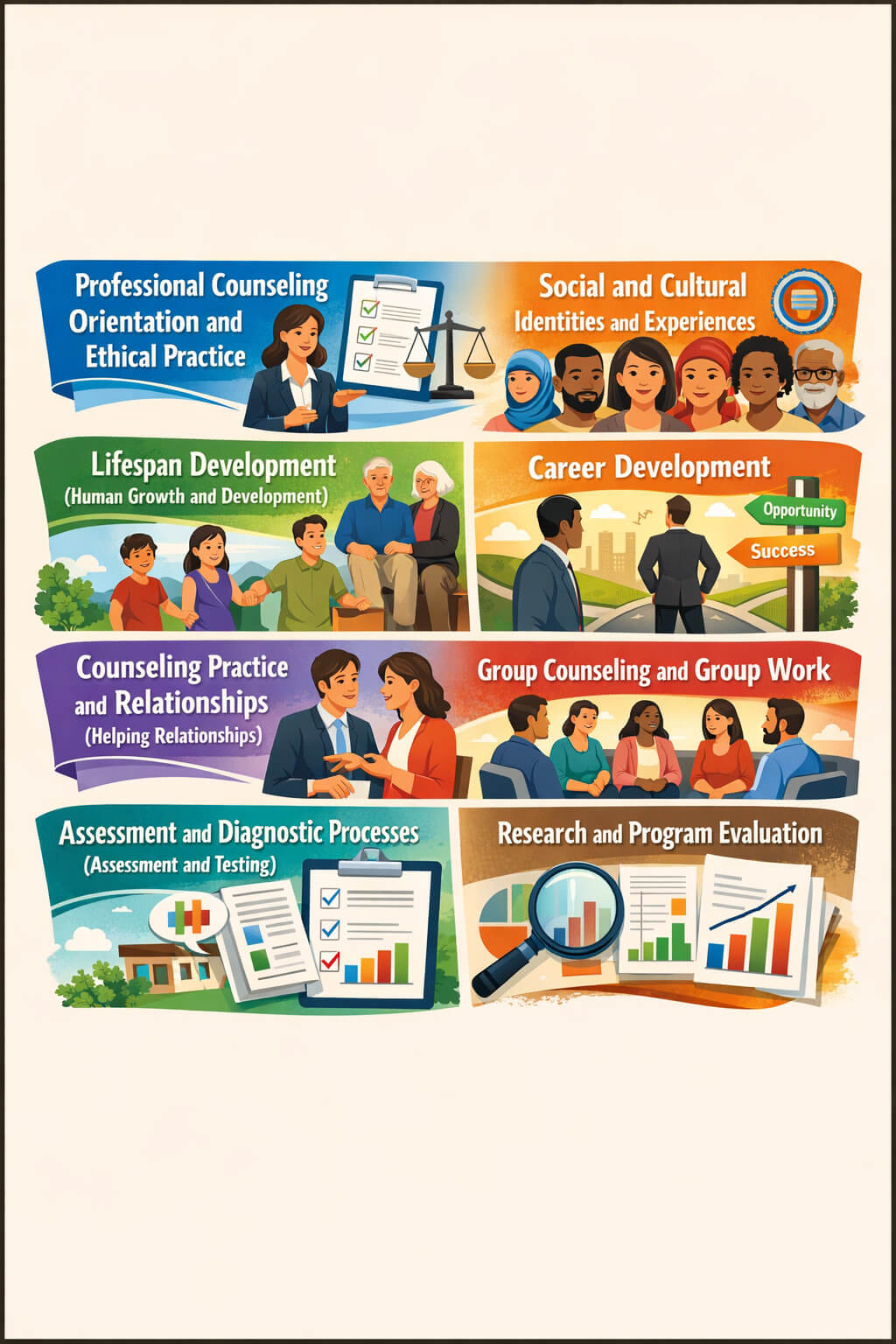
- To be CACREP-accredited, the program must teach eight core areas that shape a counselor’s professional identity, clinical skills, and ethical foundation. These include:
- Professional Counseling Orientation and Ethical Practice
- Social and Cultural Identities and Experiences
- Lifespan Development
- Career Development
- Counseling Practice and Relationships
- Group Counseling
- Assessment and Diagnostic Processes
- Research and Program Evaluation.
- The core areas of CACREP form an integrated foundation preparing students for licensure, clinical work, and long-term career growth.
- If you are considering a CACREP-accredited program, the eight core areas will form the foundation of your graduate training.
Introduction
You’re finishing up your undergraduate degree in psychology or social science. The road can be long and sometimes bewildering. There are too many schools, programs, acronyms, and licenses to keep track of. Clinical mental health work is, in its very nature, very personal, even for the clinician. It is usually felt as a calling or passion rather than merely a job. So it is understandable that you want to make the right decisions, because not only is your career on the line, but so is your sense of self and well-being.
In this article, we’re going to explore a very specific route and the core competencies it demands of its students. The CACREP curriculum lists 8 core areas of knowledge and practice for its practitioners, all of which are essential to the training and development of a clinician.
What is CACREP?
CACREP stands for Council for Accreditation of Counseling and Related Educational Programs. It’s a nationwide accreditation entity that works with specific training programs to ensure the development and training of practitioners meets their standards.
This allows a certain degree of confidence that if you end up going to a CACREP-accredited program, the training will be solid and will prepare you for your future career. These core areas fulfill the CACREP accreditation requirements.
What Are the 8 Core Areas?
1) Professional Counseling Orientation and Ethical Practice
Description: The field of mental health work is guided by a unique set of philosophical commitments and professional identities. Clinicians can occupy very different roles, from counselors to social workers in schools or hospitals. CACREP provides a central set of guidelines for professional conduct and ethical practice in the first core area to bind all of these diverse approaches together.
Key topics/points: The most important aspect of this core area is the commitment to the practice of ethical conduct and professional posturing. It means that you will make a continuous effort to grow in these areas, including engaging in research, supervision, and consultation. You will always carry your professional license and identity with you, no matter what you are doing, so it’s important that you are aware of the regulations, laws, and ethical practices that go with that.
Real-world application/personal experience: My ethics professor liked to stress to us that being a professional counselor was part of our identity. Of course, it was our entire professional identity, but it also said something about our personal identity. People don’t typically just stumble into the field of clinical mental health. It’s usually an intentional choice driven by values and beliefs. And a central value that draws people to counseling is a belief in the process of being human, not the perfection of it.
Typical courses: A very typical course in graduate school to address this core area is a class titled “This Core Area” verbatim. A good professor will also emphasize the ethical decision-making process, and you will study different orientations to making decisions and likely run through some examples of sticky situations.
Why is this area valuable? Professional orientation and ethical practice are what help a new client let their guard down a bit, knowing that they’re in good hands, that the clinician in front of them is “by the book,” and that they’re someone sensitive to both clinical concerns and also the importance of boundaries and other ethical considerations.
2) Social and Cultural Identities and Experiences
Description: Counseling practice is informed by multicultural awareness, social justice, and advocacy theories that recognize how cultural identities, heritage, and history impact the worldviews and presentations of individuals. It may seem like there is one person in front of you in the consulting room, but they bring with them many different aspects of their culture and heritage. This core area trains clinicians to tap into that space more effectively.
Key topics/points: Similarly to ethical decision-making, CACREP and professors recognize that people (even counselors) are not perfect or machine-programmed. As such, this core area emphasizes a certain attitude, not knowledge, regarding social and cultural identities. There used to be a conversation around “cultural competence,” but this has shifted towards “cultural humility” as the goal in recent years, emphasizing the learning process rather than the outcome of memorizing various aspects of different cultures. At the center of this core area is an attempt to respect and to do the most overall good you can do. This sometimes means asking with curiosity how, for instance, a person’s religion impacts their views on depression, or it can mean practicing advocacy for your client in a hospital or school system.
Real-world application/Personal experience: Depending on where you live and practice, you will have a different experience. I happen to live in a large city in a somewhat diverse area. I am regularly interacting with individuals, both clinically and as colleagues, who have very different cultural and social backgrounds and identities from me. Practicing cultural humility is essential for me in my day-to-day activities. I always try to assume I don’t know what it’s like to be someone else, and this may lead me to ask questions when relevant. For example, I run a lot of group therapy where there may be multiple different identities present at the same time. And often, this produces very lively and interesting conversations about how these identities impact the use of a certain coping skill. Lean into that difference while also emphasizing shared goals.
Typical courses: You will likely have a course called “Cultural Issues and Social Justice” or something to that effect. This class will involve a good deal of reading, writing, reflection, and conversation with peers in the class.
Why is this area valuable? Practicing awareness and understanding different approaches to culture in clinical work is becoming increasingly recognized as essential to our field. It opens up space for everyone to be empowered and included without discrimination or prejudice. And if you know anything about human flourishing, it ceases when a person’s worldview is not recognized and respected.
3) Lifespan Development (Human Growth and Development)
Description: People change throughout their lives in dramatic ways. Early psychotherapeutic theorists believed that all the important changes happened in the early years of life, but now we have come to understand that people change, develop, and grow until the end of their lives. The Lifespan Development area focuses on educating counselors in the complex dynamics of growth.
Key topics/points: Key topics in this core area include studying infancy, early childhood, adolescence, adulthood, and late adulthood, and all of the unique tasks people will face as they move throughout these stages of growth. The work of people like Jean Piaget and Erik Erikson is absolutely essential for our current understanding of these themes.
Real-world application/Personal experience: At some point, you will have to make a decision about what population to work with: children, teens, adults, or geriatrics. I chose adults from early on, so I have focused my developmental knowledge on how the early years impact the here-and-now of adulthood. For instance, if a person’s history involves emotional neglect, and they present with dissociative tendencies, I can orient my interventions and techniques to repairing (as much as is possible) that early emotional neglect to help bring the person out of dissociated states. I have many friends and colleagues who work only with children, and their understanding of early life involves a great deal of knowledge about parenting and education. Geriatric specialists will have studied and understood the impacts of aging on the body, growing isolation, and the generative/wisdom stages of late life.
Typical courses: All CACREP curricula will have at least one course on psychological development, usually titled “Human Growth and Development.” CACREP requires that students have a strong understanding of developmental psychology and the latest research and theories.
Why is this area valuable? Different tasks and issues often appear at different stages of this growth trajectory, so it’s essential that counselors have a good understanding of human development. This understanding helps orient their interventions and guides their perspective on a certain issue. For instance, identity confusion is a normal and healthy part of adolescence, but it can signal something very different if a 30- or 40-year-old has trouble identifying what makes them them.
4) Career Development
Description: For most Americans, their work-life takes up the majority of their week. It gives them access to security, food, shelter, and often a sense of well-being and purpose. There is no avoiding it: careers are important to the mental health of most people. CACREP has recognized this, and the Career Development core area reflects these facts.
Key topics/points: This core area will educate counseling students about theories and research of work and labor, how it impacts psychological well-being (and vice versa), and how to help individuals at different stages of their work-life, from building resumes to aptitude tests to interview preparation.
Real-world application/Personal experience: Though I am not a Career Counselor, I have conversations daily with clients about their work. This core area and my training in it have prepared me to discuss these dynamics with clients with confidence. For instance, people with depression often struggle to get themselves to work and make it through the day. If a depressive episode is in its early stages, I can recognize this and start having those conversations about the importance of keeping a routine schedule with work, not only for their mental well-being but also for their material stability.
Typical courses: There is often a course simply titled “Career Counseling.” It will involve reading about theories and research, writing papers, and discussing the dynamics of our contemporary world of work.
Why is this area valuable? Most people work or have worked the majority of their lives. Many people will get laid off at some point, want to change careers, or struggle with moving up in their field. So it’s important for the counselor to be prepared and trained to have conversations with confidence and direction that address these ubiquitous issues.
5) Counseling Practice and Relationships (Helping Relationships)
Description: Counselors use relational skills, ethical and legal awareness, technology, consultation, documentation, and evidence-based interventions to support client change, collaborative goal-setting, and measurable outcomes. Effective practice also often includes crisis and suicide response, trauma-informed and community-based interventions, medication/biology awareness, caseload and referral management, and the ongoing development of a personal counseling model grounded in theory and research. That’s a lot of responsibility on the counselor!
Key topics/points: This core area encompasses the bulk of what it means to be a counselor on a day-to-day basis. It does indeed involve tasks as diverse as setting goals with clients, managing a referral system, and practicing evidence-based interventions in session. The courses that cover this core area will reflect this diverse nature, preparing counseling students to master and grow in the field when things get messy.
Real-world application/Personal experience: I work part-time at an Intensive Outpatient (IOP) program and part-time in private practice. My days at the IOP are incredibly dynamic and diverse. I may do all the following in one day: treatment planning with a new client, do a session focused on trauma with an ongoing client, consult with a psychiatrist about a particular medication regimen’s side effects, and run a group teaching emotion regulation skills. Like any profession, it feels overwhelming at first, but with practice and dedication (and a healthy dose of self-compassion), these dynamics become interesting, not problematic.
Typical courses: You will see a few courses that address this core area. It’s common, for instance, to take a course specifically on trauma and crisis, learn treatment planning and case conceptualization in a different class, and learn how to measure outcomes in yet another class.
Why is this area valuable? The daily work responsibilities of a counselor vary tremendously, and this core area addresses the fundamental tasks and practices of the field. It will prepare you to start thinking like a counselor, which means thinking in a different way about clinical work and mental health than you might be used to.
6) Group Counseling and Group Work
Description: When we think of counseling or psychotherapy, a lot of us think about private conversations between two people: a client and a clinician. A lot of psychotherapy takes place among multiple people at once, sometimes four to ten. This kind of work is called group counseling or group work, and it is a core area of CACREP. This core area prepares counselors to facilitate these groups by understanding group dynamics and theories that orient how groups are structured.
Key topics/points: Interpersonal dynamics take the forefront of these courses, and the counseling student is trained in how to recognize and track how these dynamics emerge and unfold in real time. It’s a very different way of listening to and relating to people, one that is more attuned and cued into how people relate to each other. Key topics in this area include theoretical models of interpersonal dynamics, stages of how these dynamics unfold, and how to use this understanding to inform and guide interventions.
Real-world application/Personal experience: I work in an IOP setting, which means I am facilitating groups for nine hours each week. I have always loved working with groups. It’s exciting and challenging in all the best ways. Most clinicians will do group work in their careers. The majority do it at the beginning, but there are plenty who fall in love with it and continue it until they retire. My class on groups (and my own personal experience in a group) prepared me for how it feels to be in a group and how it feels to facilitate a group.
Typical courses: This core area will be addressed in a course for groups. These courses are fascinating because they usually involve practical engagement along with theoretical learning. Many professors will run mock groups and have students rotate in facilitating. This sounds scary, but if the professor is competent, it will feel safe and exploratory rather than threatening. And paired with the theoretical study of group dynamics, the practice comes alive in a wonderful way.
Why is this area valuable? People get better together. That’s why the therapeutic relationship is so important in a one-on-one setting. But it also means that group therapy can offer a different level or kind of benefit to people struggling with their mental health. Groups serve as the cornerstone for higher levels of care, like IOP or even inpatient, but they also work very well in outpatient, private practice settings. People benefit immensely from groups, usually more than they think, and the world needs more competent counselors who offer groups.
7) Assessment and Diagnostic Processes (Assessment and Testing)
Description: Assessment and Diagnostic Processes get right to the heart of clinical work. Whether you work in private practice and get a new client or implement assessment as part of your work in general, you will be engaging in practices and procedures that are known as diagnostic and assessment measures. This can look very different from assessment to assessment and from setting to setting, so generalizing what this core area looks like is difficult. Both assessment and diagnosis in most environments are the attempts by a professional to grasp, in a structured or semi-structured format, the person’s clinical presentation.
Key topics/points: Key points in Assessment and Testing include the understanding and administration of various kinds of assessments and tests, including IQ measures, aptitude tests, and various diagnostic procedures. Understanding the process of diagnosis is as important as memorizing diagnoses in the DSM and elsewhere. Diagnosis is part of the treatment of the client’s problems, not separate from it, so the clinician will be taught how to remain flexible, adaptive, and careful when working with diagnosis and assessment.
Real-world application/Personal experience: Working in higher levels of care will require more specialization and discipline when it comes to assessment and diagnosis. In the IOP setting I work at, I see each client for around six weeks, which means I need to be at least somewhat confident that my diagnosis and, therefore, my treatment plan for that client are solid within the first few meetings with them. In most clinics, colleagues hold what are called “clinical rounds,” wherein the treatment team discusses each case. In these settings, it is encouraged (if the clinic is healthy) to share doubts or questions related to diagnosis, which I do regularly. This helps me gain competency and sharpen my diagnostic skills, demonstrating that even in condensed treatments, diagnosis is a process.
Typical courses: There will likely be two separate courses related to these issues, perhaps more: one course for diagnosis and the other for assessment. Though these topics overlap immensely, they don’t always speak to each other. For instance, administering a battery of personality assessments won’t necessarily tell you anything about the client’s clinical diagnosis, and vice versa. Each of these classes will teach you to be confident and competent in the process of assessment and of diagnosis.
Why is this area valuable? Most clinical mental health work is oriented by the medical-scientific systems of thought, which means that diagnosis is the bedrock of the clinician’s orientation to treatment. Assessment and diagnosis help you wrap your head around what’s called the “clinical picture” or “presentation” of the person in front of you, not in order to gain some kind of mastery over them, but to help you maintain your position as a clinician. The importance of this element in clinical practice cannot be overstated.
8) Research and Program Evaluation
Description: Clinical mental health counseling and related fields are rooted in scientific and medical orientations. This means that the clinician is simultaneously a scientist (of sorts)! The model of modern counseling programs is often referred to as producing “practitioner-scholars” or some variant of the theme, meaning that research is as important as grounded clinical practice. This core area makes it so that CACREP-accredited programs teach their students how to read, interpret, and produce research, as well as how to measure their clinical work and the work of agencies and groups.
Key topics/points: If you struggled with statistics in undergrad, fear not. You will be covering statistics in these courses, but it is less mathematically intensive. The emphasis is on reading research with enough competency that you can integrate it into your clinical practice. Another key topic of this core area is how to measure your own outcomes with clients and how to assess the efficacy of an agency or group you work with. Most agencies these days keep records of progress and outcomes of their clients, so the clinician needs to familiarize themselves with these processes so that clinical work becomes self-aware.
Real-world application/Personal experience: I regularly read research, even far out from grad school and deep into the world of clinical work. I challenge myself to read 2-3 articles published within 10 years per week and think about how to incorporate the findings when I can. It’s perhaps a strange method, but it works for me, and I encourage you to find ways to regularly engage with research in the field you work in. It keeps you sharp and engaged and decreases burnout because it increases confidence and efficacy.
Typical courses: You will see one or two courses in your CACREP program that address this core area. You will do a lot of reading and research, so get comfortable with looking through databases and reading through dry academic journals. The course will teach you engaged reading. So you will not be reading half-mindedly as you might do with your newsfeed, but you will be reading critically, studying, and synthesizing as you go. Finally, you will likely be asked to design a research project or program to familiarize yourself with the process.
Why is this area valuable? If Clinical Mental Health Counseling is to remain in the field of medical science as much as possible, research is going to be an essential part of its practice. The CACREP curriculum recognizes this and teaches students how to become competent practitioner-scholars.
How the 8 Core Areas Work Together
At this point, we have covered the 8 core areas of a counseling program curriculum. Programs that train future counselors who have a CACREP accreditation will offer many classes, and almost all of them will address one or more of these core areas directly. And while the areas are presented as separate for bureaucratic reasons, the keen-eyed reader will have already sensed that some of them echo the others, and all of them depend on the others.
You may argue, for example, that a counselor who is ethical and professional is well-trained in the diagnosis and assessment of mental health concerns. You may also argue that a counselor who is invested in research and evidence-based practice will be passionate about continuing to learn about other cultures.
Think of the 8 core areas as an eight-legged table. If one or two go, the others must bear the weight, and the table will be rickety and lopsided. If more go, the table is falling over. Consider how each core area supports and even deepens the others.
Specialization Tracks (overview)
These 8 core areas of CACREP are general and fundamental, meaning that they are essential to the curriculum at any and all levels of specialization tracks. But how they are taught and which aspects of each area are emphasized will vary slightly within each specialization.
The specialization tracks are
- Addictions Counseling
- Career Counseling
- Clinical Mental Health Counseling
- Clinical Rehabilitation Counseling
- Marriage, Couple, and Family Counseling
- Rehabilitation Counseling
- School Counseling, College Counseling and Student Affairs
- Counselor Education and Supervision
FAQ
It depends. CACREP accreditation requires regularity and uniformity when it comes to curriculum design from program to program. But professors vary, states vary, and universities themselves vary. On top of that, what aspects of each core area are emphasized will depend on the specialization you choose.
Yes. The licensure exams will directly reflect these 8 core areas, and the questions on the exams are organized according to these areas.
This depends on the program, but it ranges in most programs from 2 to 4 years, depending on whether you are attending part-time or full-time. Usually, core areas are the first classes you will take, and then you will move into extracurricular hours and finally into clinical hours (practicum and internship).
Closing
In this article, we addressed a fundamental aspect of a CACREP-accredited program: the 8 core areas. These areas form the shared basis of all CACREP programs across the United States by emphasizing adherence to a high standard of the training and education of future professional counselors and clinicians.
If you are considering pursuing this profession and want to learn more about CACREP and the core areas, head over to their website at cacrep.org/ and bounce around the pages for articles and videos. Additionally, when you are in the process of looking for programs to enroll in, it may be helpful to speak with college administrators and ask about how their program fulfills CACREP core area requirements.