
It can be overwhelming when trying to pick a program to complete for your graduate education. From determining what you want to focus on in your studies, to campus life, and the academics of the program, it can be a difficult decision to decide where you want to receive a degree.
For counseling in particular, the gold standard for programs are those that are CACREP accredited. The CACREP, or Council for Accreditation of Counseling and Related Educational Programs, takes a careful look at various graduate school programs across the country to determine if they meet criteria for accreditation eligibility. Accreditation is important for potential students, graduate school programs or entire universities, professional businesses or agencies in the mental health field, and for the public eye.
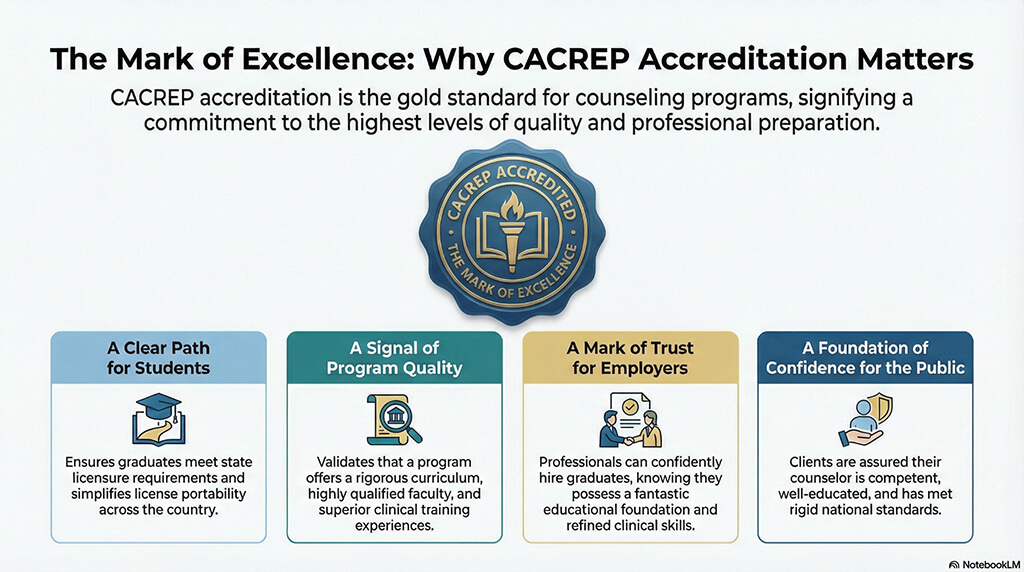
Accreditation Overview: Why it Matters
What is accreditation, and why does it matter? To be accredited by the CACREP means that a program or university has met rigid criteria for its programs in the following areas: curriculum, faculty, quality, and student outcomes. According to the CACREP’s website, the accreditation process is broken down into many different areas, such as visitations on campus for a program evaluation and reporting those findings back to a board that ultimately makes the decision if a program is eligible to be accredited. Accredited programs are highly esteemed, draw in more students, are professional acknowledged, and look good to the public.
Potential students, current students, and alumni can rest assured knowing that CACREP sets them up for success in the field of counseling. A requirement for accreditation is for a program to have high-quality practicum experiences and opportunities, courses and faculty so that graduates of a CACREP-accredited program can meet licensure requirements in states across the United States. Let’s dig deeper into the importance of accreditation for various entities.
Importance of Accreditation for Programs & Universities
Graduate school programs for mental health clinicians or counselors strive to be accredited with CACREP for a few different reasons. As noted above, one of the biggest reasons a program would be accredited is so the graduates are fully prepared to meet licensure requirements in their respective field. With the accreditation also comes an enhanced program reputation and status in higher education and is more attractive to students.
When a program is CACREP accredited, it knows it is offering a rigorous academic program that offers high-quality content for education, faculty that are exceptionally qualified, and clinical experience that truly prepares students for work in the field. For many programs and universities, they can stand out as top schools with this accreditation and help potential students make well-informed choices on where to pursue their education.
Another reason a program or university may want to be accredited is to showcase the work they’ve put into developing their program for specific career advancement and program focus. Meeting the criteria for CACREP accreditation means the program has taken the time and effort to produce the best quality curriculum, practicum experiences, student experiences, and journeys, and to curate the best faculty.
Importance for Students
Choosing a school or program that is CACREP-accredited is often very important to students. When choosing to pursue acceptance and enrollment into an accredited program, students know they are setting themselves up for success. Because states use these programs as their standard for licensure, students who graduate feel confident knowing they will be eligible for licensure after graduation.
CACREP accreditation can also be important for students who are frequently on the move and relocating to new states. Rather than trying to obtain licensure in a new state and follow their state guidelines, the CACREP-accredited degree allows for super-easy license portability between states. In fact, there are some states that require their licensure applicants to be graduates of an accredited program. These states include Ohio, Kentucky, North Carolina, and recently added to the list, Florida.
Expert Perspective: My Experience

By Aly B.
LMFT-S
Nova Southeastern University
Although I did not graduate from a CACREP- accredited program, I did graduate from a COAMFTE-accredited program, which is for marriage and family therapy in particular.
Choosing this type of program allowed me to feel very prepared for application of clinical skills after graduation, studying for and passing my licensure exam, and ready to handle high-risk populations because of the practicum experience.
Professional and Public Benefits
Accreditation is vital for programs and students, but it also plays a big role in the public and professional perceptions. Professionals in the mental health field often feel confident when hiring graduates from a CACREP-accredited program because they know the individual has had a fantastic foundation in their education and clinical work. This often makes a candidate stand out for a job because the employer knows the clinician can bring excellent services, refined clinical skills and high levels of knowledge to their business or agency. Professional settings also know that they will not have to utilize as many resources to develop a clinician who has graduated from an accredited program because the program has already met rigid standards to be distinguished as one of the best.
The public eye may not be as familiar with CACREP or what accreditation means. With the proper explanation or search, they soon realize that having a counselor who is an alumni of an accredited program is what they’re aiming for as they search for mental health support. For many of us who have sought out mental health services, we want to know our clinician is educated, confident, and knows what they’re doing so they can help us. Clinicians or businesses who mention that their clinicians are graduates of accredited programs are offering another level of confidence to potential clients.
Putting it All Together
The process for programs or universities to become accredited with CACREP can be a long and tedious process, but it is well worth it in the end. Putting in the work to ensure a program offers the best academic curriculum on counselor education and preparation makes a big difference in the quality of the program. CACREP accreditation makes the program more desirable to potential students who know they’ll be able to achieve licensure after graduation. Professionals in the field understand the great graduates these programs produce, making them more likely to get hired. Finally, the public can trust that those tending to and supporting their mental health are qualified and competent.