

TL;DR
- The Council for Accreditation of Counseling and Related Educational Programs (CACREP) accredits counseling and other professional health programs according to certain standards.
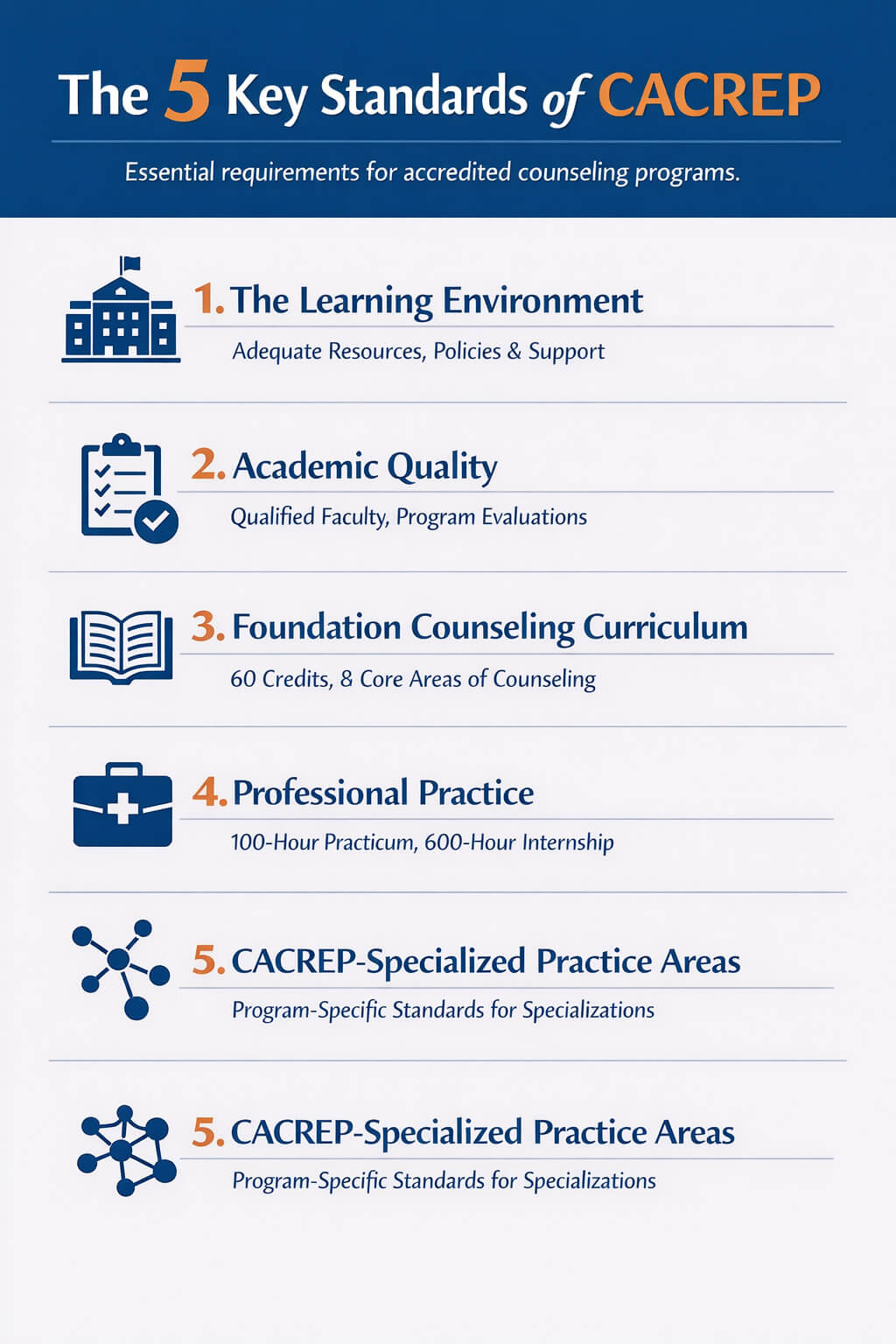
- The five foundational standards are The Learning Environment, Academic Quality, Foundational Counseling Curriculum, Professional Practice, and Entry-Level Specialized Areas.
- A program which meets these standards with self-evaluations and program structuring can apply for accreditation from CACREP.
- Accreditation standards do not vary state-by-state, but it is important to familiarize yourself with your specific state laws and regulations in addition to CACREP.
Introduction
CACREP accreditation standards are the criteria used by the Council for Accreditation of Counseling and Related Educational Programs (CACREP) to evaluate graduate counseling programs in the United States. These standards define requirements for curriculum, faculty qualifications, student learning outcomes, clinical training, and institutional support.
The Council for Accreditation of Counseling and Related Educational Programs (CACREP) is a national accreditation organization body which oversees the training and education of professional counselors and related healthcare professionals. Every clinical program in a university that seeks CACREP-accredited must meet certain standards. These standards include academic quality, the kinds of courses taught, and the requirement for supervised clinical experience to ensure that graduates are well-prepared for their roles as professional counselors. Standards are essential for our field of work because the work can be very diverse in its nature, and therefore it becomes important to establish and communally agree upon certain ideas about what it means to be a professional counselor and how to maintain excellence in training programs across the nation.
In this article, we will cover the Five Core CACREP Standards. These standards are the flagship of their accreditation requirements. The current list was cemented in 2024 and is the most recent iteration. Most of what programs need to fulfill to meet CACREP-accredited standards is found underneath the umbrella of these five core standards. We will cover each one and then move into the specifics of seeking accreditation.
The Five Core CACREP Standards Sections
The Learning Environment
The Learning Environment refers to the way that the counseling program is structured and organized so that the student can meet their educational goals in the university program. These specifications range from what should be included in the student handbook to how and why IT support should be provided to the qualifications of the educators. The Learning Environment is both broad in scope and fundamental in forming the organization and processes of ‘The Institution,’ as it’s referred to in the Standards.
This standard maintains certain environmental qualities of the institution so that the student can focus on their learning and education. Things need to run smoothly for deep learning to take place, and it is the responsibility of the program to ensure the environment is conducive to such learning.
Academic Quality
Academic Quality has to do with the striving towards and assessment of student and faculty performance. CACREP demands that the program has systematic and regular ways of objectively measuring progress and areas of improvement over time, including students’ comprehension of the 8 Core Areas (addressed below), faculty’s teaching capacities, and internship/practicum placements of students. Academic Quality assures the prospective student that the program takes itself seriously and has practices of reflection and evaluation built into the program itself, keeping its outcomes at the forefront of its development and orientation.
Additionally, every few years (either two or eight, depending on various factors), the program must submit a self-assessment to continue their participation in CACREP accreditation. Self-assessment and self-evaluation thus takes place on the micro level (individual students evaluating their instructors and other factors) and the macro level (the program evaluating itself).
Foundational Counseling Curriculum
In another article, we go into detail about the 8 Core Areas of the counseling curriculum, so here we will give an overview of each one. The Foundational Counseling Curriculum is the nuts and bolts of the education of the student. These areas orient which courses are taught and what areas of knowledge to prioritize in the training of the counseling student.
For students, what matters is the output of that process:
- Mattis elementum
- Eget suscipit nulla metus
- Sed interdum urna ante
Why Do People Care So Much About CACREP?
Because in many places, “what you studied and where” affects how easily you move through licensure reviews, how portable your degree is across states, and (in some settings) whether you meet employer requirements. CACREP itself notes it is named in licensure laws/regulations in many states and can lead to expedited educational review in licensure processes.
What CACREP Is and What It Is Not
CACREP is the Council for Accreditation of Counseling and Related Educational Programs. It is a specialized, programmatic accreditor for master’s and doctoral counseling programs and their specialty areas.
What does CACREP accreditation mean in plain language?
It means a counseling program has voluntarily undergone a structured review process against established standards (curriculum, clinical training, faculty qualifications, program evaluation, and more) and has been granted accredited status by CACREP.
CACREP describes U.S. accreditation as a peer-review system, where programs submit a self-study that is reviewed against standards by counselors and counselor educators.
Does CACREP Accredit Schools or Specific Programs?
Programs. CACREP’s own guidance is explicit: it is the degree-specific program that holds accreditation, not the department or the university as a whole.
Is CACREP the Same as a Counseling License?
No. Licensure is handled by your state licensing board, and it includes multiple requirements beyond education (often exams and supervised post-degree hours). CACREP even states directly that graduating from a CACREP-accredited program is not a guarantee you will obtain licensure.
Professional Counseling Orientation and Ethical Practice
Professional orientation and ethical practice are what give the student confidence and competence in the field of counseling. Being a professional counselor is a responsibility that comes with ethical and professional demands to be upheld. Professional Counseling Orientation and Ethical Practice courses will teach the basics and the processes for thinking in an ethical and professional manner.
Social and Cultural Identities and Experiences
It is impossible and unhelpful to avoid studying cultural, social, and political impacts on mental health and healthcare as a profession. CACREP has recognized this and has built the systematic study and knowledge of Social and Cultural Identities and Experiences into its required curriculum. These courses help students understand how the individuals they work with swim in larger systemic forces.
Lifespan Development
Lifespan Development courses teach counseling students about developmental psychology in detail with an emphasis on how and why to use this knowledge in clinical work. These courses will address cognitive, physical, emotional, and social tasks and problems as they emerge throughout the lifespan of a person using theoretical and research perspectives.
Career Development
Counseling students in a CACREP-accredited program will learn about what issues may come up in a person’s career and work-life and how to help clients move through these problems. Career Development is all about how to use research and theory to best orient a counselor when faced with their clients’ (all too common) career obstacles.
Counseling Practice and Relationships
If there is one constant of clinical research, it’s that the relationship between the clinician and the client is foundational in the treatment of almost any presenting mental health problem. As such, CACREP has included a standard for instructing students in recognizing the importance of Counseling Practice and Relationships as a whole, how to use theories to orient clinical practice, and how to conceptualize clinical complaints. These courses will also prepare students for the day-to-day responsibilities of a counselor.
Group Counseling and Group Work
The CACREP core area of Group Counseling and Group Work requires that programs offer a course on how to facilitate group therapy. The popularity and efficacy of group work makes it essential for all students to understand and gain competence in this area. These courses will have theoretical work (reading, writing) as well as hands-on practice (running a group with peers as mock clients).
Assessment and Diagnostic Processes
Assessment and Diagnostic Processes is a foundational learning requirement for emerging professional counselors because it grounds and orients clinical practice. Without proper assessment and diagnostic skills, a counselor cannot know how to work with a client from an evidence-based perspective. As such, it is one of the core areas of a CACREP-accredited program.
Research and Program Evaluation
Research is an essential component of any counselor’s education and training, both in their graduate school and in the professional world. It’s important that the counselor understands how to interpret, analyze, and review research findings and programs, like clinical agencies or even school programs.
Professional Practice
A Master’s Degree in Professional Counseling is, in the end, clinical. Which means that there will be a great deal of practical engagement with the work of counseling, much like learning any trade. CACREP-accredited programs ensure that their students get access to placements and support in practicum and internship sites. This includes infrastructure for the new clinician to practice, adequate supervision in the university program and at the external internship site, and technical support as needed.
Entry-Level Specialized Practice Areas
We have written elsewhere about CACREP specializations, so I won’t go into detail here. But an essential component of the practicum and internship experience is that it aligns with the student’s chosen specialization. For instance, a student specializing in Addictions Counseling should be able to work with clients with addictions in their practicum and internship phases of the program.
The Five Key Standards of CACREP
Preparing Your Program for CACREP Accreditation Review
If you are looking for how to get accredited with CACREP, there are obviously some important things to keep in mind. First, you’ll want to get familiar with their website, cacrep.org, where you will find resources, announcements, and a landing page for accreditation status. Next, you will need a Program Liaison: someone who is a go-between for your program and CACREP. They will work as the primary point of contact between the two.
The bulk of the work will be designing your program to meet the CACREP standards of 2024 if you are preparing to be accredited for the first time. If you are reviewing your program accreditation, you will need to complete a detailed self-assessment/self-evaluation and submit it to CACREP. The CACREP board then meets once per year to review all of these decisions (sometimes up to 200 requests from across the country). The kinds of decisions they make can be found in a table here.
All of the forms you will need (a Self-Assessment, an application, etc.) can be found in the Accreditation Management System (AMS) and can be found here.
State Requirements
CACREP, as we have mentioned, is a nationwide regulatory board. That means that it works across state lines. However, we also live in a country in which state lines matter when it comes to professional licensing in almost every field of work, and counseling is no exception. Therefore, it is as important to familiarize yourself with your state regulations as it is with CACREP regulations. The two often work together, but it’s important to know when they don’t!
Some states require CACREP-accreditation to work as a counselor in their state (e.g., Colorado and California); others prefer it (e.g., Louisiana and Maine), while still others have no requirement or preference regarding it (e.g., Texas and Michigan). There is a great interactive map found here if you’re wondering what the status is in your state.
Furthermore, each state has its own regulatory department that you can and should contact regarding laws and regulations of professional counseling in your state. If you don’t know what your state board is, it takes a quick web search for “[My state] counseling regulatory board.” Alternatively, here is a list of boards by state: https://aascb.org/Counseling-Board-Resources.
Note: Licensure requirements vary by state. Prospective counselors should verify requirements with their state licensing board.
Why CACREP Accreditation Matters for Counseling Careers
As mentioned above, there are some states which absolutely require CACREP accreditation to practice as a professional counselor, but there are other important things to consider about job outlook and career opportunities.
It is common that clinical positions within the Veteran’s Admninistration (VA) require that their counselors’ programs be CACREP-accredited, as well as many federal jobs in general. Depending on your state, it is also common for some employers to prefer CACREP over non-CACREP accredited counseling degrees.
For more information on the specifics of job outlooks down to the state level, check out the Bureau of Labor Statistics (BLS) on the counseling profession: https://www.bls.gov/oes/2023/may/oes211019.htm
Expert Perspective

By Sean Carroll
Psychotherapist (LPCC, LAC)
In my experience, as with many other counselors I have spoken with, the major benefit of a CACREP accreditation is transportability between state lines. Each state has its own licensing board, and you need to be licensed in a certain state to work there as a clinical professional. So, if I am licensed in Colorado, I cannot see clients based in New York or Texas. However, I can apply for an NY or TX license and see clients in those states. If I want to do that, then I will likely need to supply their licensing board with some additional paperwork and maybe take another standardized test. However, it is well-known that CACREP-accredited programs have more transportability power given that CACREP is itself an interstate regulatory board. It will make it easier for New York, for instance, to assess whether or not my education has met certain standards.
That is the major benefit of attending a CACREP-accredited program. I have worked with countless clinicians from programs which are not accredited, and I have not noticed a persistent or generalizable difference between the clinical skills and knowledge between CACREP-graduates and non-CACREP-graduates. As such, the emphasis in difference should be placed on future career decisions and efficiency.
Research it Yourself
Every now and then CACREP will update its standards to meet the needs of the time. The most recent standards were released in 2024, and the full file can be found here (the previous standards were released in 2016). But it is important to stay updated on changes made.
The two best ways to do that are to occasionally check their website (cacrep.org) if you are seeking accreditation or are looking for graduate programs and to join the email list for your state regulatory department, as they will regularly send out important announcements and changes in the field as a whole.
FAQs About CACREP Accreditation Standards
This is a foundational question, and it’s good to get back to the basics now and then. Accreditation, for CACREP, is simply the status gained by a graduate program (not a college, university, or even a person) for adhering to CACREP Standards as defined above. This accreditation must be sought by the program itself.
A: In an ideal world, it would guarantee program quality all the way through. However, we will live in a world of institutions and organizations, and these are made up of people. And in my experience, dealing with people is never ideal. A CACREP-accredited program is guaranteed a certain amount of quality as a whole, meaning that you know you will take certain courses (e.g., Diagnosis and Assessment). But it does not guarantee that every professor will be excellent, that supervision will be perfect, and so on.
These sections of your graduate program (arguably the most important!) will ensure that you will get placement in a site (either internal or external to the program itself) and that you will see clients with supervision and consultation. Practicum consists of 100 clinical/direct hours, and internship consists of 600, usually taking students three semesters to complete.
Well, certainly you can ask administrators or professors if you are already a student! But if you’re still looking for a program, the CACREP website has a database you can sort using filters to find the program that’s a good fit for you here.
Conclusion
The 2024 CACREP accreditation standards outlined above are what constitute the foundation of a program’s orientation to training professional counselors. These five standards (Learning Environment, Academic Quality, Foundational Counseling Curriculum, Professional Practice, and Entry-Level Specialized Practice Areas) must be practiced and continually revisited by each program to ensure accreditation standards are met.