

CHEA (Council for Higher Education Accreditation) recognizes accrediting bodies that meet quality and accountability standards in higher education. In the counseling and broader mental health degree accreditation space, programs that are accredited by CHEA recognized accrediting bodies can provide graduates with a smoother path to licensure and allow for more flexibility when seeking licensure in different states.
CHEA Key Takeaways
- CHEA accreditor recognition matters because licensure boards, employers, and institutions often rely on CHEA-recognized accreditation when evaluating degrees
- The primary CHEA-recognized accreditors for counseling programs include CACREP, MPCAC, COAMFTE, and ACES
- For licensure portability and employment, the most commonly preferred and required accreditation for counselors is the CACREP accreditation
- Other CHEA-recognized accreditations can still lead to licensure and employment but may require additional coursework, documentation, or state-by-state review.
- The key difference between CACREP and other accreditors is alignment
- CACREP is closely tied to professional counseling licensure standards
- Other accreditors emphasize different clinical identities, focus of education, or non-clinical careers.
Important disclaimer: Accreditation impacts licensure eligibility but does not guarantee licensure, which is ultimately determined by individual state licensing boards based on each applicant.
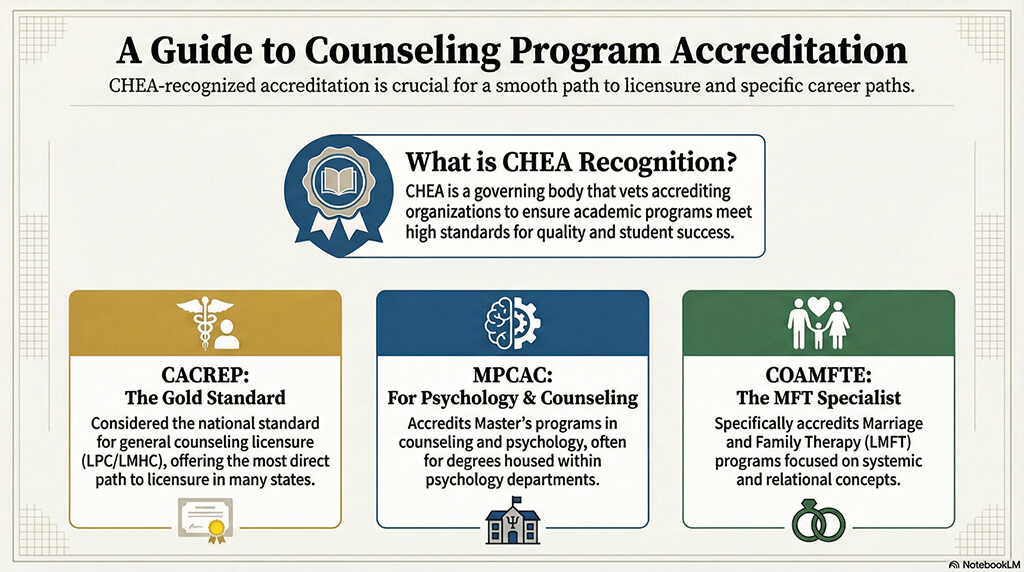
What Is CHEA (Council for Higher Education Accreditation)?
The Council for Higher Education Accreditation (CHEA) is a governing body that reviews accrediting organizations to ensure their standards for academic programs align with the values and missions of higher education. Accrediting organizations are those that develop curricula for academic programs for various careers, such as those working in healthcare and mental health. CHEA is responsible for maintaining high academic quality and peer-reviewed research in these programs. The US Department of Education (USDE) also works with accrediting organizations; however, its primary goal is around government funding for education, such as federal student aid.
When an accrediting program or body is recognized by CHEA, it means that CHEA has examined the quality and effectiveness of academic standards to ensure the programs go above and beyond any federal requirements for funding and focus on the improvement of higher education in general. This stamp of recognition for academic quality is very important. Academic programs recognized by CHEA have a strong emphasis on things like student success, continuous improvement, fairness, innovation, accountability, and commitment to diversity and autonomy. This also helps employers feel confident in hiring individuals who graduated from an accredited and recognized program, for they know the high quality of the program prepared the potential employee.
For mental health professions and graduate programs, CHEA works with:
- CACREP (for counselors)
- COAMFTE (for marriage and family therapists)
- MPCAC (psychology and counseling)
All these accreditors benefit individuals applying for licensure, as many state licensing boards recognize these types of programs as meeting all requirements for the education needed to gain licensure.
There are two different types of accreditation: programmatic and institutional. The main difference between the two is that programmatic accreditation covers only a professional program, while institutional accreditation covers the entire institution. For example, a university may have a CHEA-recognized accreditation program for engineering, but the university as a whole is not. Another school may be accredited as an entire institution for quality standards, but some of their programs may go for an additional programmatic accreditation.
What Is Counseling Program Accreditation?
For counseling programs in particular, they often fall into the category of programmatic accreditation. This means that counseling programs have met educational standards set by CHEA to ensure that graduates from the program are competent in their area of study. Programmatic accreditation for counseling is different from regional or institutional accreditation because it specifically looks at expectations for eligibility for the profession or field of study, not just higher education in general. Many CHEA-recognized accreditation bodies also have approval from the state that the academic standards meet or exceed expectations for licensure. For counseling programs not accredited, the state needs to review syllabi and course descriptions to ensure the proper education goals have been met to grant licensure.
Accreditation sets the standard for high-quality professionals, but it also helps protect students, employers, and licensing boards. Through their carefully vetted standards, accrediting bodies make sure they uphold values for many individuals directly or indirectly related to the program.
Accreditation can be evaluated through the following measures:
- Curriculum Standards: Programs have curricula that allow graduates to meet state education requirements for licensure.
- Faculty Qualifications: Chosen faculty to teach are role models in the field and uphold research values and higher education standards
- Clinical/Practicum Requirements: Provide opportunity for students to learn and gain high-level clinical skills upon graduation.
- Outcomes and Assessments: Accreditation looks at data and facts to have reportable and tangible numbers.
CHEA-Recognized Counseling Accreditation Organizations (Ranked & Explained)
For the mental health field in particular, there are a few accrediting organizations to explore:
The first accreditation to dive into is the Council for Accreditation of Counseling & Related Educational Programs, also known as CACREP. CACREP specifically works to accredit counseling programs and was developed in the early 1980s to become the one accrediting body for counseling. This accrediting body does have recognition from CHEA and covers counseling specialties such as clinical mental health counseling, school counseling, addiction counseling, marriage and family counseling, and rehabilitation counseling. For those interested in pursuing the LMHC (licensed mental health counselor) or LPC (licensed professional counselor) credential, finding a CACREP program is a great place to start. The accredited program is good for both master’s and doctoral- level students.
CACREP (Council for Accreditation of Counseling & Related Educational Programs)
CACREP is considered to be the gold standard for counseling accreditation. To meet criteria for accreditation, the CACREP ensures that programs have a rigorous academic program and clinical training. By doing this, it ensures that graduates can meet state licensing requirements and can produce high-quality work within their field of practice. Those counselors who did not come from a CACREP-accredited program may have a longer wait time before licensure is granted due to state licensing boards needing to verify academic course completion and clinical internship experience. A limiting factor of the CACREP accreditation is that there are few options for non-clinical tracks if someone doesn’t want to work in a clinical realm.
MPCAC (Masters in Psychology and Counseling Accreditation Council)
Another popular accreditation council is the Master’s in Psychology and Counseling Accreditation, which is better known as MPCAC. This is also one of the accrediting bodies that HEA recognizes for excellence. MPCAC was developed in 1995 and awarded accreditation to those who had a master’s degree in psychology, since CACREP only accredits counseling-type programs. Because MPCAC is good for psychology degrees, those institutions that have a wider variety of program offerings within the realm of psychology. A MPCAC-accredited program is good for those hoping to pursue a Master’s degree, but it does not cover programs that offer a doctoral degree.
One of the most significant differences between the MPCAC accreditation and the CACREP accreditation is that programs housed within a psychology department can be accredited with MPCAC, but not CACREP. Programs can be credentialed with MPCAC with a more diverse staff, including those faculty who are not licensed mental health providers. Contrary, CACREP accreditation occurs when faculty also hold licenses for clinical work. When it comes to limitations, MPCAC accreditation may have less flexibility or more complex processes when it comes to licensure.
When it comes to obtaining licensure after graduating from an MPCAC-accredited program, applicants may see that they are required to take extra coursework related to state rules that pertain to their licenses. There are plenty of individuals who successfully become licensed; however, the process may have a few additional steps compared to those who have graduated from a CACREP program. The following states have been known to accept the MPCAC accreditation: Arizona, California, Colorado, Florida, George, Hawaii, Illinois, Indiana, Kansas, Kentucky, Maryland, Massachusetts, Mississippi, Missouri, New Jersey, New Mexico, New York, Oklahoma, Oregon, Pennsylvania, South Carolina, Texas, Utah, Washington, and Wisconsin. Commonly known employers and work sites that hire individuals from MPCAC programs include local hospitals and clinics, community mental health centers, court systems or agencies, and non-profit organizations.
COAMFTE (Commission on Accreditation for Marriage and Family Therapy Education)
The next accreditation we will review is COAMFTE. This stands for the Commission on Accreditation for Marriage and Family Therapy Education. Similar to the ones already discussed, COAMFTE is also recognized by CHEA and accredits programs at both the Master’s and Doctoral levels.
What makes COAMFTE accreditation a bit more unique is that it is specific to marriage and family therapy programs only. This means that those pursuing a generalized counseling degree would not attend a COAMFTE program. Marriage and family therapy programs differ from traditional counseling programs in that their education is heavily focused on systemic and relational concepts, theories, and clinical interventions. Because COAMFTE accredits programs with curriculum on working with families and couples, obtaining licensure after completion of an accredited program leads to quicker licensure. LMFT-licensed candidates need a specific number of client contact hours that are relational, meaning they’ve provided clinical care to families and or couples.
Other accreditors for counseling focus on high-quality education and clinical experience in their programs; however, they tend to be more generalized. COAMFTE ensures programs have a primary focus on systemic work, making its graduates exceptionally prepared to work with relationships in the clinical setting, such as in family therapy, couples therapy, or even organizational therapy. Graduation from a COAMFTE accredited program shows licensing boards that candidates have specialized education to work in specific niches. Some may view this as a limitation, because it is so focused on relational and systemic work and not the general field of counseling.
My Personal Experience Graduating from a CHEA-Recognized Accreditation Program
Back in 2018, I completed my Master’s degree in Marriage and Family Therapy from a COAMFTE-accredited program. Having this program under my belt allowed me to get licensed in multiple states with ease. When I first applied for licensure in the state of Florida, I had no hiccups with the licensing board. I then moved and applied for my LMFT in Texas, thinking I would have to go through hoops to obtain licensure. Because my degree came from a CHEA-recognized accreditor, I was able to get licensed in two states with ease and had no additional education requirements to complete. Additionally, I applied for my Registered Play Therapist credential, and again, my academic transcript was reviewed and accepted with no questions. Being able to meet career goals without having to do extra steps has made my professional journey that much easier.
ACES & Other Related Recognized Bodies
Another recognized body that many have heard of is ACES. ACES is the Association for Counselor Education and Supervision. This entity primarily focuses on helping counselors advance their education in the respective field, as well as a focus on supervision for the development of their clinical skills and services. Much of the work ACES does is to ensure that counselor education is up to date on culturally relevant factors in the field of mental health.
ACES is different than accreditors because it is a professional organization with regional chapters and conferences. Accreditors primarily evaluate a program or institution to make sure regulations and educational quality are being honored. A professional association exists to support its members of the association. For example, ACES supports its members with counselor education. Members can be graduate students, licensed clinicians, and faculty.
It is not uncommon to get professional associations and accreditors mixed up. Common professional associations for counselors or psychologists include:
- APA: American Psychological Association
- ACA: American Counseling Association
- AAMFT: American Association of Marriage and Family Therapy
- CSWA: Clinical Social Work Association
Professional associations often have different branches of memberships for regions or states where members can connect with colleagues close to their geographical location.
Comparison Table: CHEA-Recognized Counseling Accreditors
| Accrediting Organization | CHEA- Recognized? | Program Focus | Degree Levels | Licensure Alignment | States With Explicit Preference | Best For | Limitations |
|---|---|---|---|---|---|---|---|
| CACREP (Council for Accreditation of Counseling & Related Educational Programs) | Yes | Professional counseling (clinical mental health, school counseling, addictions, rehab, etc.) | Master’s & Doctoral | Very strong alignment with LPC/LMHC licensure; often considered the national standard | Many states explicitly prefer or require CACREP (e.g., TX, FL, KY, OH, NC, GA, VA, IN, TN, AR) | Broad licensure within counseling field | Prescriptive standards can reduce program flexibility; fewer non-counseling tracks |
| MPCAC (Master’s in Psychology & Counseling Accreditation Council) | Yes | Counseling and general psych | Master’s | Generally aligns with LPC/LMHC licensure, but may require additional review or coursework in some states | Few states explicitly prefer MPCAC; usually accepted but not prioritized | Hybrid for those interested in counseling and psychology or non clinical | Less name recognition; portability can be more complex in CACREP-preferred states |
| COAMFTE (Commission on Accreditation for Marriage & Family Therapy Education) | Yes | Marriage & Family Therapy using systemic and relational models | Master’s and Doctoral | Strong alignment with LMFT licensure requirementnationwide | Most states with LMFT licensure explicitly recognize or prefer COAMFTE | Relational work, family therapy, couples therapy | Not appropriate for some licensure paths; due to narrow scope |
| ACES (Association for Counselor Education and Supervision) | No (Not an accrediting body) | Counselor education, supervision, leadership research, advocacy | Grad students, Master’s level, Doctoral level, licensed people can be members | Does not provide program accreditation or direct licensure alignment | None | Therapy educators supervisor, doctoral students, and counselor leaders | Frequently misunderstood as an accreditor; membership does not affect licensure eligibility |
Frequently Asked Questions
CHEA recognition means that accrediting organizations meet a standard of education to provide high-quality, diverse, and fair education within an academic program.
Yes, CACREP is recognised by CHEA.
The CHEA recognized counseling accreditors are: CACREP, MPCAC and COAMFTE.
You can check if a program is CHEA-approved by visiting the CHEA website. Specifically, they have a directory of institutions and programs that can be accessed via https://www.chea.org/directories